Lecture 04 - Randomness
In our first lecture, I provided you with Philip Galanter’s definition of generative art
Generative art refers to any art practice in which the artist uses a system, such as a set of natural language rules, a computer program, a machine, or other procedural invention, that is set into motion with some degree of autonomy, thereby contributing to or resulting in a completed work of art.
A key piece here is that we are ceding some level of control to a process. There is a fine line here since we are writing the code about what it actually means to cede control to the process. The mouse following tutorial we did, for example, caused one of you to question if it was really “generative art”. I would (and did) argue that there is still an algorithmic process happening, but it is a fine line.
sketch 1
let position;

function setup() {
  createCanvas(600, 600);
  position = createVector(width / 2, height / 2);
  strokeWeight(10);
}

function draw() {
  point(position.x, position.y);
}
this has some minimalistic appeal, but this is pretty boring
This introduces a new function: createVector. The vector is a p5js type that holds vector information. This is a mathematical vector, rather than the type you may have encountered in 201. There are a number of functions available for manipulating vectors, but for right now we are just using it for its ability to hold 2D position data.
sketch 2
let position;

function setup() {
  createCanvas(600, 600);
  position = createVector(width / 2, height / 2);
  strokeWeight(10);
}

function draw() {
  background("white");
  point(position.x, position.y);

  position.x = max(0, min(position.x + random(-3,3), width));
  position.y = max(0, min(position.y + random(-3,3), height));
}
this is more dynamic, but it is still pretty plain
sketch 3
let position;

function setup() {
  createCanvas(600, 600);
  position = createVector(width / 2, height / 2);
  strokeWeight(10);
}

function draw() {
  point(position.x, position.y);

  position.x = max(0, min(position.x + random(-3,3), width));
  position.y = max(0, min(position.y + random(-3,3), height));
}
we have to remove some code, but it has become a little more interesting
sketch 4
let position;

function setup() {
  createCanvas(600, 600);
  position = createVector(width / 2, height / 2);
  strokeWeight(25);
  stroke(0, 3);
}

function draw() {
  point(pos.x, pos.y);

  position.x = max(0, min(position.x + random(-3,3), width));
  position.y = max(0, min(position.y + random(-3,3), height));
}
Add a little bit of color
sketch 5
let position;
let hue = 0;

function setup() {
  createCanvas(600, 600);
  colorMode(HSB, 360, 100, 100, 100);
  position = createVector(width / 2, height / 2);
  strokeWeight(10);
}

function draw() {
  // background("white");
  stroke(hue, 100, 100, 10);
  point(position.x, position.y);
  position.x = max(0, min(position.x + random(-3, 3), width));
  position.y = max(0, min(position.y + random(-3, 3), height));

  hue = (hue + 360 + random(-5, 5)) % 360;
}
with a small addition to how the point is visualized, we have made this much more interesting (though I won’t claim it is riveting)
What are we (or maybe just I) responding to? Complexity At each step, I added a little more complexity - random movement - movement trace - transparency so we can see where it dwells - color for a little interest
We are attracted to complexity this doesn’t mean complicated or perplexing (though it can) we mean systems that have a lot of component pieces that are interacting
Complexity can lead to emergence - characteristics that are unexpected or more than the sum of the parts, as it were
Sometimes this means that we get patterns that we didn’t expect Others, we get true chaotic behavior with non-linear, unpredictable results
To me, this is one of the draws of generative art – the idea that I can write all the code for a system and still be surprised
Galanter uses complexity theory as a lens for talking about different kinds of generative art
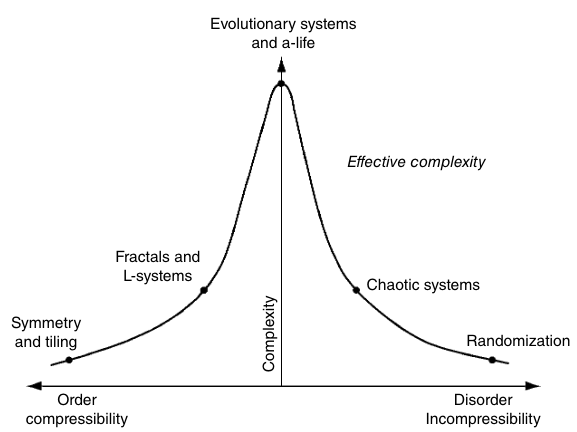
Philip Galanter, “Generative Art Theory”
We have already visited the two extremes of this. We have looked at tiling and L-systems and randomization
Today we will dig into randomization a little bit more
Generating random numbers
where do we get random numbers?
- rolling dice
- flipping coins
- shuffling cards
- people?
- people are notoriously poor at generating random numbers
- natural sources of entropy
- random.org
- pseudo-random number generator (PRNG)
Hopefully you realize that computers all use some form of pseudo-random number generator
example: (sin(x) * 1000) % 1
> x = 1
1
> x = (Math.sin(x) *1000)%1
0.4709848078964569
> x = (Math.sin(x) *1000)%1
0.764089112496265
> x = (Math.sin(x) *1000)%1
0.879613174955125
This is basically just diving deep into the less significant bits of the sine function We wouldn’t actually use this sequence for anything important like cryptography – we would need something with some provable statistical properties (the Mersenne Twister is a more robust example that uses shift registers and matrix linear recurrence… and no, I don’t know how it works)
In JavaScript, the standard leaves the choice of random number generation to the implementer of the interpreter… so basically you are at the mercy of your browser.
The essential point is that what we think of as a random number generator is actually just a fixed sequence of numbers based on an initial seed value. If we start from the same seed, we get the same sequence.
A nice feature of this is we can get repeatable pseudo random numbers
We have been using the random() from p5js we have never talked about the seed and we aren’t getting repeated behavior, why not?
If we don’t set the seed with randomSeed then it is set for us, usually using the current time so that every run is unique.
Considerations when using random numbers
bounding and parameterization
pure randomness is usually too messy in the color flurry, I used a smaller range to bound the colors and sizes for aesthetic reasons
this will be a common approach for us as generative artists when we are using randomness, we will think about the parameters of the system and what the appropriate ranges are for the parameters
parameterization in and of itself is a whole technique that generative artists will often use, wether or not the parameters are then randomized. We can think of a lot of what we do as defining a search space of possible designs and then swimming around to find one that we like. randomness is just one way to do that exploration.
Another approach is to think in terms of applying random variance instead of generating random values this bounds the value into a local region the region may travel with the value, but we are making small changes instead of big radical ones
discrete vs continuous
we also want to think about whether we want continuous values or discrete ones
We can think in terms of breaking up the range of our random values into bins.
What if we wanted something that would happen 70% of the time?
if (random() < 0.7) {
  do_thing();
} else {
  do_other_thing();
}
our random function can take in an array and it will return a random value from the collection of options
What if we want weighted discrete values? One approach that works well is to load multiple copies into an array
[A,B,C,A]
- A, 50%
- B 25%
- C 25%
distribution
Our random number generator approximates a uniform distribution – any value in the range is equally likely
p5js also provides randomGaussian(), which will give us a Gaussian distribution it has two optional parameters
mean- the mean value to center aroundsd- the standard distribution
take a look at the distribution sketch
We aren’t limited to these for distribution